

Table of Contents
- Why Wire Bristles Are a Real Food Safety Risk
- Quick Comparison: Best Tools for Cleaning Barbecue Grates
- Safe Grill Brush Alternatives That Actually Work
- How to Clean Grill Grates Without a Wire Brush
- Matching Tools to Grate Material: Stainless, Porcelain, and Cast Iron
- Grill Grate Maintenance Tips for Long-Term Performance
- Conclusion
- Frequently Asked Questions
Last Updated: September 16, 2026
Why Wire Bristles Are a Real Food Safety Risk
Metal bristles that shed from a worn grill brush can end up in the food you serve, and they do not announce themselves. A bristle lodged in a burger or a chicken breast travels down the throat and can perforate the esophagus or intestine, which is why the CDC warning on wire-bristle grill brushes treats this as a genuine injury risk rather than a freak accident.
Quick Comparison: Best Tools for Cleaning Barbecue Grates
The best tools for cleaning barbecue grates fall into four practical categories, each suited to a different grate material and mess level. Steam brushes handle routine grease on stainless and porcelain, while scrapers and mesh pads tackle carbon buildup on cast iron.
| Tool Type | Best For | Grate Compatibility | Effort Level |
|---|---|---|---|
| Steam-cleaning brush | Routine grease, sanitizing | Stainless, porcelain, cast iron | Low |
| Bristle-free mesh head | Light carbon buildup | Stainless, porcelain | Low |
| Metal scraper | Heavy carbon buildup | Cast iron only | High |
| Coil or spring brush | General grime removal | Stainless, cast iron | Medium |
Safe Grill Brush Alternatives That Actually Work
Safe grill brush alternatives replace exposed wire with steam, mesh, or solid scraping surfaces, so there's nothing to shed into your food. The three designs below cover almost every home grill.
Steam-Cleaning Brushes
A steam-cleaning brush channels water onto a preheated grate, where the water flashes to steam and lifts grease and grime off the surface. This is the method Grill Daddy Brush Company built its line around, using a simple preheat and water-fill process rather than chemicals. Steam reaches into the crevices between grate bars where a scraper can't, and it sanitizes as it cleans.
Bristle-Free Kevlar and Mesh Heads
Bristle-free heads use woven mesh or a heat-resistant Kevlar pad to scrub without any loose metal. Mesh pads work well for light carbon buildup, and because there are no bristles, there is no ingestion risk. The trade-off is that mesh wears down on heavy carbon and needs replacing more often than a solid scraper. For grates that only see routine maintenance, a mesh head is a reasonable low-effort choice.
How to Clean Grill Grates Without a Wire Brush
To clean grill grates without a wire brush, preheat the grill, apply steam or a mesh scrub, then wipe the surface down before it cools. The full sequence takes about ten minutes on a warm grill.
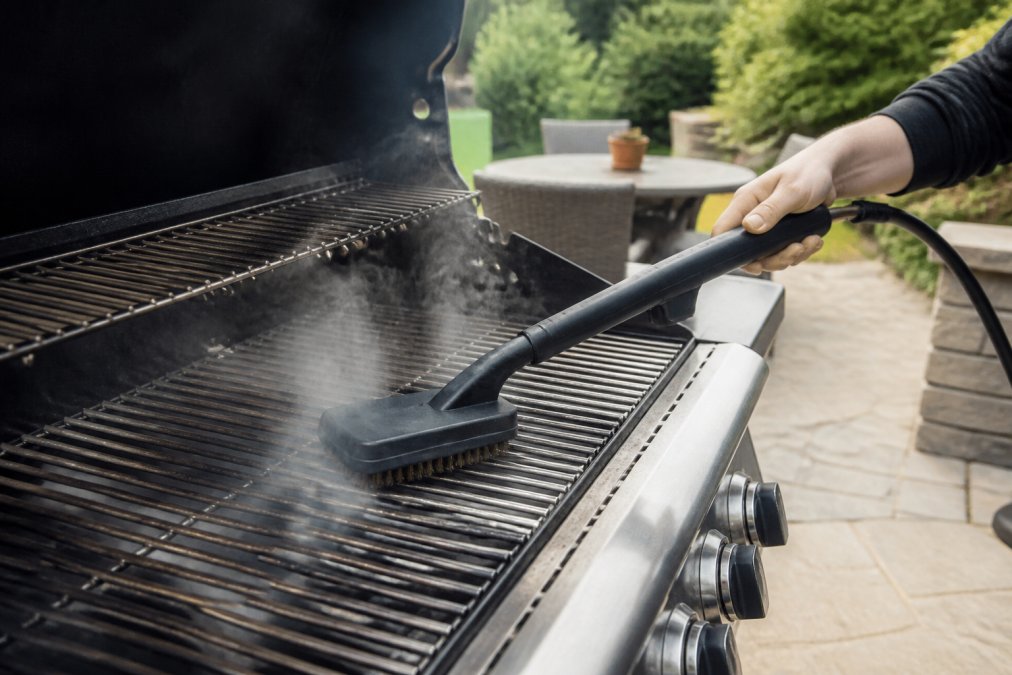
- Preheat the grill on high for 10 to 15 minutes to soften residue.
- Fill your steam brush reservoir and run it along each grate bar.
- Scrub stubborn spots with a mesh pad or coil brush.
- Wipe the grates with a damp cloth to lift loosened grime.
- Oil the grates lightly before your next cook to slow future buildup.
Matching Tools to Grate Material: Stainless, Porcelain, and Cast Iron
Grate material decides which tool is safe, because abrasive metal scratches some surfaces, does nothing to others, and can permanently ruin a coating. Before you buy anything, identify what your grates are actually made of, a magnet is the fastest field test. Stainless steel and cast iron are magnetic; most porcelain-enameled grates are not, because the enamel coating over the steel or iron is non-ferrous.
Stainless Steel Grates
Stainless is the most forgiving surface. Steam brushes, bristle-free mesh heads, coil or spring brushes, and nylon detailing brushes all work without damage. The one thing to avoid is heavy-gauge wire, not because stainless can't take it, but because a stiff wire brush on a hot grate is the exact combination that sheds bristles. Stainless also hides residue well, so scrub until the bars feel uniformly smooth rather than until they look clean, a shiny bar can still carry a film of polymerized grease.
Porcelain-Enameled Grates
Porcelain is a glass coating over steel or cast iron, and it fails the same way glass does: chips, crazes, and flakes. Once the enamel is compromised, moisture reaches the steel underneath and rust starts from the inside. That is why the tool rules here are strict:
- Safe: steam-cleaning brushes, soft nylon bristle brushes, non-abrasive mesh pads, and wooden scrapers.
- Unsafe: metal scrapers, wire brushes, coil brushes, and anything with a hard edge that can catch a chip.
- Also avoid: thermal shock. Running a cold, wet brush across a screaming-hot porcelain grate can crack the enamel, so let the grate cool to warm, roughly the temperature where you can hold your hand a few inches above it for a few seconds, before you scrub.
Cast Iron Grates
Cast iron is the opposite case: it wants abrasion and it wants oil. A metal scraper or a stiff brush is appropriate here, followed by a steam pass to lift the loosened carbon, then a light re-oil while the grate is still warm so the seasoning layer rebuilds. Never soak cast iron or run it through a dishwasher, the seasoning is a polymerized oil layer, and soap and long water exposure strip it.
Scrapers, Coil Brushes, and Utility Attachments
Beyond the main head, a few attachments earn their place in a grill toolkit:
- Metal scrapers, flat-bladed tools for cast iron and stainless only. The right call when residue is thick enough that you can feel ridges with a gloved hand.
- Coil or spring brushes, a spiral of thick wire rather than fine bristles. Fewer, larger strands mean less shedding risk than a traditional wire brush, but they are still metal and still off-limits for porcelain.
- Nylon detailing brushes, for the corners, the firebox, and the gaps between bars where a full-size head won't reach.
- Wooden scrapers or grill stones, a low-tech option for porcelain that lets you apply pressure without a hard edge.
Grill Grate Maintenance Tips for Long-Term Performance
Most guides stop at "clean your grates after every cook." That advice is correct but incomplete, because the real variable is not how often you clean, it is what you are cleaning off, and whether the tool you use is actually removing it. Two things matter that almost no grill guide addresses: the difference between visible grease and invisible biological residue, and the fact that different grill types (gas, infrared, ceramic, charcoal) put different demands on the same grate.
Routine vs. Deep Cleaning: Two Different Jobs
Routine cleaning happens while the grill is still warm, within about 15 minutes of pulling food off. At that point residue is still soft, and a steam brush or mesh pad lifts it in a minute or two. Deep cleaning happens every few cooks and targets carbonized, baked-on buildup that routine passes can't touch. Skipping routine cleaning is what forces deep cleaning, the longer grease sits, the harder it polymerizes into a shell that only abrasion or prolonged steam will break.
- After every cook: steam or mesh pass while warm, then a light oil wipe.
- Weekly: full steam session plus a scrape of any ridged spots.
- Monthly or every few cooks: deep clean, including the firebox and the underside of the grate bars.
- Seasonally: inspect heads for wear, replace frayed mesh, and re-season cast iron.
Sanitization and Food Safety Beyond Bristles
Bristle ingestion gets the headlines, but the more common food-safety issue is what grows on a grate that was never fully cleaned. Grease and carbon buildup create a porous layer that traps moisture and food particles, a surface where bacteria can survive between cooks. Heat kills most of what is on the grate surface during preheat, but it does not remove the carbon layer those organisms live in, and it does not reach residue on the underside of the bars or in the firebox.
Match the Method to the Grill Type
Tool requirements shift with the grill, not just the grate:
- Gas grills, the most common setup. Steam and mesh work well; the main risk is grease dripping into the firebox, so clean the bars and the heat deflectors on the same schedule.
- Infrared grills, the burner emits radiant heat through a perforated panel. Never scrub the infrared emitter itself; clean the grate above it and let the burner self-clean at high heat. Abrasive tools can clog or damage the emitter's holes.
- Ceramic or kamado grills, the thick ceramic walls hold heat and are fragile. Use soft tools only, avoid thermal shock, and never pour water into the firebox.
- Charcoal grills, grates are usually cast iron or chrome-plated steel. Cast iron gets scraped and re-oiled; chrome-plated steel gets treated like porcelain and kept away from metal.
Tool Longevity and Storage
A brush that lives outside in the rain will rust at the head and shed faster than one stored indoors. Rinse and dry heads after use, hang them rather than leaving them on the grate, and retire any head, mesh, coil, or bristle, the moment it shows fraying, missing strands, or a loose crimp. For cast iron, re-oil after every deep clean; for everything else, a light oil wipe on warm grates slows the next round of buildup.
Conclusion
Keeping a grill safe and clean comes down to choosing tools that don't shed, scratch, or leave residue behind. Grill Daddy Brush Company builds steam-cleaning brushes with patented SAFE BRISTLE-LOCK technology, bristle-free Kevlar head options, and a design that works on stainless, ceramic, and iron grates, all made in the USA and backed by a lifetime warranty. Get started with Grill Daddy Brush Company and cook on a grate you can actually trust.
Frequently Asked Questions
What is the best thing to clean your grill grates with?
Steam-cleaning brushes and bristle-free scrapers are the safest options for cleaning barbecue grates. Steam brushes use heat and water to melt grease and sanitize the surface without chemicals, while bristle-free designs eliminate the risk of loose wire bristles ending up in food. For routine maintenance, a long-handled scraper or mesh pad works well on cooled grates. Avoid abrasive steel wool on porcelain-enameled surfaces, and always preheat before scraping to loosen carbon buildup.
Are steam-cleaning brushes safe for all grill types?
Steam-cleaning brushes work on stainless steel, porcelain-enameled, and cast iron grates when used as directed. The heat and moisture soften grime without scratching surface integrity, unlike stiff wire bristles that can gouge porcelain. For cast iron, dry the grates thoroughly after steaming and apply a thin layer of oil to protect the seasoning. Check the manufacturer's guidance for your specific grill, and avoid soaking ceramic-coated grates in water for extended periods.
How do I prevent wire bristles from getting into my food?
The most reliable prevention is switching to a bristle-free alternative, such as a steam brush with a Kevlar head or a coil-design scraper. If you still use a wire brush, inspect it before every use and replace it at the first sign of loose or bent bristles. After brushing, wipe the grates with a damp cloth or oiled paper towel to catch any stray bristles. The CDC has documented injuries from ingested wire bristles, so inspection and replacement matter.
Can I use dish soap like Dawn to clean my grill grates?
Dish soap works for degreasing cooled grates during a deep clean, but it is not a substitute for routine maintenance. Mix a few drops with warm water, scrub with a non-abrasive pad, then rinse thoroughly and re-season cast iron or carbon steel. For weekly upkeep, steam cleaning or dry scraping removes residue without soap and avoids leaving detergent behind on the cooking surface. Save the soap-and-water method for end-of-season deep cleans.


